
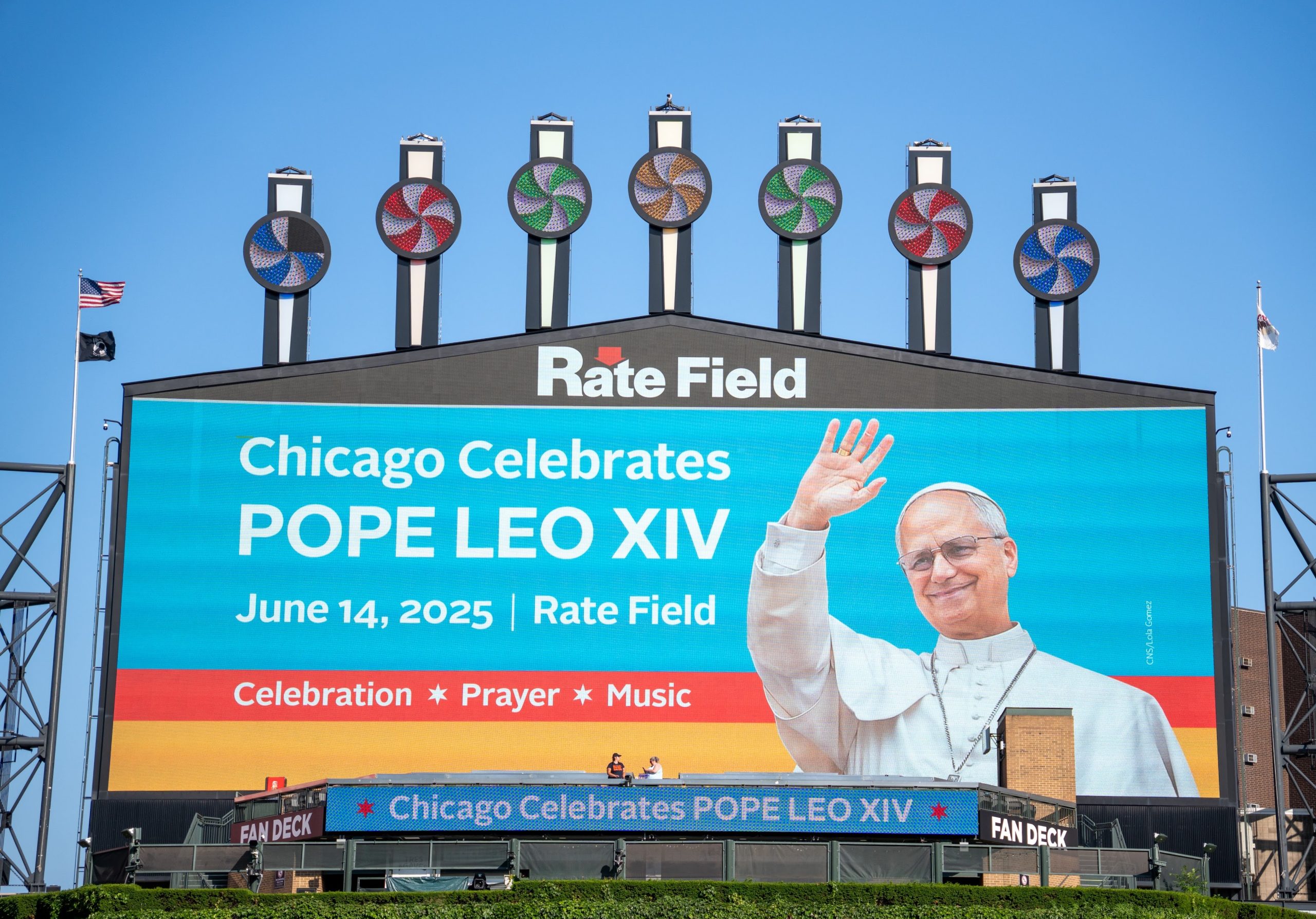

Just hours after walking across the stage at DePaul University, I found myself stepping onto the outfield grass of Guaranteed Rate Field — not for a baseball game, but for a once-in-a-lifetime celebration: A mass celebrating the newly elected Pope Leo XIV, the first American pope and a proud son of Chicago. Dressed in my graduation gown and surrounded by tens of thousands of faithful, I was swept into an unforgettable moment of civic pride, spiritual unity, and personal joy.
I attended the event with my dad, godmother, uncle, and fellow The Chicago Report contributor Joey Bacino and his father. As we made our way through the crowd, we ran into a friend’s mom who, to our amazement, offered us on-field passes for the Mass. Standing just feet from the altar during Cardinal Blase Cupich’s homily and Pope Leo XIV’s video message from the Vatican, Joey and I felt the magnitude of what was unfolding: history, faith, and hometown pride, all converging on a beautiful sunlit June afternoon.
The weather was perfect, the energy electric. Before the Mass began, I was approached by reporters from the Sun-Times and CBN (Christian Broadcasting Network), both curious about the sight of a fresh college graduate in full regalia among the sea of believers. I spoke about how meaningful it was to be there — not just as a Catholic, but as a Chicagoan — watching the world celebrate one of our own in such a unifying, spiritual way.

The celebration, filled with music, prayer, and Pope Leo’s heartfelt message of hope and service, felt especially resonant after years of division and uncertainty. As the pontiff called on young people to embrace community and purpose, I couldn’t help but reflect on how fitting it was to begin my post-grad life with a message so grounded in humility and action. It’s hard to imagine a more powerful way to end a chapter and start a new one. June 14th wasn’t just a day of celebration for the Catholic Church — it was a uniquely Chicago day, and for me, an unforgettable personal milestone woven into the fabric of history.
Leave a Reply